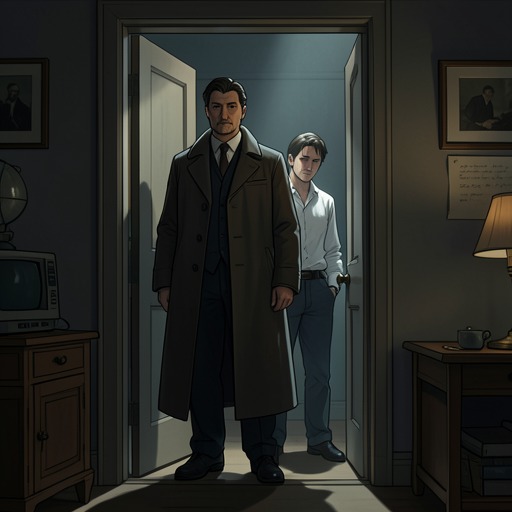
Dream of confusion between the carriage, railway, and brother
The Interpretation of DreamsFreud’s dream of confusion between the carriage, railway, and brother turns a jumble of journeys into a demonstration of how dream-work can manufacture absurdity on purpose. A cab ride is made to run along a railway, the driver merges with Freud’s brother, and a tangled play on the German verb for travelling conceals judgments about family, aristocracy, and ancestry. The dream’s confusion is not an accidental defect in the account: Freud reads it as the means by which a critical thought enters the manifest dream.
The dream and its waking circumstances
Freud introduces the dream after a meeting with Count Thun, before his holiday journey. In the dream, he rides in a hansom cab and tells the driver to take him to a railway station. When the driver objects, Freud replies that he cannot travel with him on the railway line itself, although the dream also seems to place them already on a stretch normally covered by train. The scene repeatedly turns on fahren, the German verb for travelling or driving, and on its changing forms. The result is an apparently incoherent account in which cab and railway, present and prior journeys, and different travellers refuse to stay distinct.
The first waking memory behind the cab is a ride to a remote street in Dornbach. The driver did not know the route and continued on until Freud noticed the mistake and showed him the way, making scornful remarks in the process. Freud connects this driver with Count Thun: the aristocrat, he says, drives the Austrian state coach. That association brings social rank and the image of taking the driver’s seat into the dream’s chain of meanings.
A second journey brings Freud’s brother into the same scene. Freud had cancelled their planned trip to Italy that year, in part as punishment for his brother’s usual complaint that the journeys wear him out: Freud expected too many changes of place and too much sightseeing in a single day. On the evening of the dream, his brother accompanied him to the Westbahnhof, then left to take the local train to Purkersdorf. Freud had suggested that he could accompany him farther by taking the main-line train instead. In the dream, the cab replaces the local train, bringing the brother and the cab-driver together in a single representative figure.
How the confusion is constructed
Freud stresses that the waking journey had run in the opposite direction from the dream’s arrangement. He had told his brother that they could travel together on the main-line train along the same stretch that the brother would cover by local train. The dream recasts that offer as travelling in a cab along a stretch usually travelled by rail, and its substitution of cab for local train makes the cabby available to stand for the brother as well. Freud treats this mixture as a condensation of two figures, not as a mere lapse in memory.
That explanation does not by itself account for the dream’s most conspicuous contradiction: Freud says both that he cannot travel with the driver on the railway line and that he has already travelled with him along such a stretch. He sees no practical need to mix the local train with the cab, so he concludes that the dream has shaped the puzzling, self-contradictory story intentionally. Its construction, rather than simply the people and places it contains, becomes evidence for what the dream is doing.
Puns, rivalry, and the wish to be an ancestor
The missing link comes from two riddles Freud had heard that evening at the home of a hospitable and witty woman who appears elsewhere in the same dream as a housekeeper. He had been unable to solve them while the other guests already knew the answers, and recalls that his failure made him look ridiculous. The riddles turned on Nachkommen, meaning descendants or those who come after, and Vorfahren, meaning forebears or those who go before, as well as travelling or driving ahead. Their verbal associations furnish the dream with a reason to make fahren confusing and absurd.
Freud connects this wordplay to his response to Count Thun. Seeing the Count drive ahead imperiously had put him in a mocking mood: he judged that the grandees’ only merit was having taken the trouble to be born, making them descendants. The dream’s thought, as Freud reconstructs it, reverses that pride in lineage. Rather than take satisfaction in forebears, he would prefer to be one himself—to become an ancestor. His brother’s presence in the cab-driver figure follows from the same network: aristocrats and coachmen can be associated through the act of driving, while the local custom of addressing a coachman as brother-in-law makes the familial connection available as well.
The dream’s apparent nonsense thus gives shape to a judgment: pride in one’s ancestors is itself nonsense. Freud interprets the confused image of having driven earlier with the cab-driver through another play on the language of having driven ahead. The absurdity is tied not just to a forgotten route or a mistaken vehicle, but to the critical thought running through the dream’s puns and substitutions.
What absurdity expresses
Freud generalizes from the case that a dream may become absurd when a latent thought contains a judgment that something is nonsense, or when an unconscious train of thought is shaped by criticism and mockery. In this account, absurdity functions as one of the dream-work’s ways of expressing contradiction, alongside reversing the relation between dream-thought and dream-content and using motor inhibition. It does more than insert a simple negation: it reproduces the impulse to ridicule while contradicting.
This example therefore makes intentional absurdity part of Freud’s account of how latent content becomes manifest. The cab, railway, brother, and aristocrat are not assembled into a coherent journey; their very failure to cohere permits a private criticism to appear in disguised form. Freud also associates absurd dream-making with conflict around paternal authority: a father’s authority can provoke a child’s criticism, while filial devotion, intensified in thought after the father’s death, increases the censorship against expressing that criticism consciously. The present dream’s specific chain concerns Freud’s brother and Count Thun, but it belongs to that broader argument about how mockery and contradiction can surface under censorship.